The short answer
The stamped concrete vs pavers decision is usually a trade-off between the finish you want, the initial price and how you expect to maintain or change the area. A simple stamped concrete finish can cost less upfront. Pavers are easier to lift and reset when access or local repairs are needed. Neither option fixes poor drainage or inadequate preparation.
We build stamped surfaces, but that does not make them the best answer for every yard. Compare the same footprint and preparation before deciding that one quote offers better value.
Stamped concrete
- Good fit: you want a textured concrete surface and do not expect to open it up later.
- Budget: a straightforward finish may reduce the initial bill, although elaborate detailing can close that gap.
- Trade-off: future patching may remain visible, and the protective finish needs attention.
Interlocking pavers
- Good fit: individual replacement, future access or changing the layout matters to you.
- Budget: compare the complete paving system, including excavation, bedding and restraints, not just the units.
- Trade-off: uneven areas and the spaces between units still need inspection and upkeep.
A poured surface or separate pieces?
Stamped concrete is poured in place, colored and impressed while it is workable. The imprint can resemble stone, brick or wood, but the result is still a continuous concrete slab rather than separate stones. Concrete slabs still need planned movement-control cuts; the visible texture does not replace them.
Concrete pavers are manufactured units laid over a prepared supporting system. This comparison focuses on those units. Fired-brick pavers, natural stone and porcelain have different characteristics and prices; they should not be treated as interchangeable products.
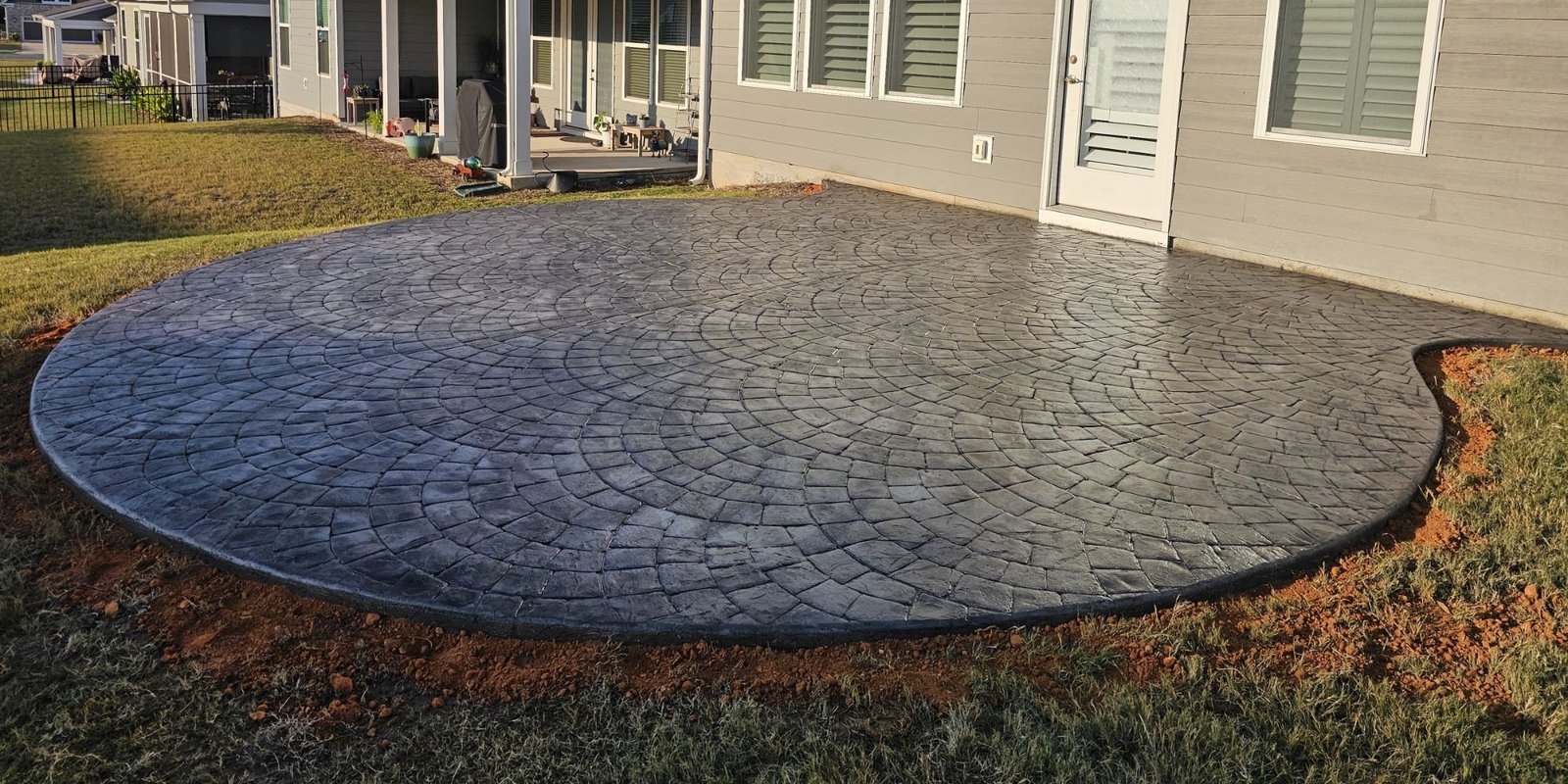
Structure illustrations, not installation details.
Compare the complete price, not just the square foot
Basic stamped concrete often has an upfront price advantage, but that is not a rule for every job. A complex finish with several colors and borders may overlap the price of a simpler paver installation. Restricted access, removal and drainage work can matter more than the difference between two finishes.
When asking what pavers cost, first confirm which product and installation method the figure covers. An advertised supply-only price cannot be compared with a complete installed quote.
Preparation
Both bids should address removal, excavation, disposal and the supporting base. Ask what happens if unsuitable fill or soft ground is uncovered. Leaving those allowances out can make the lower bid misleading.
Design and edges
Compare the same dimensions, curves, steps and border treatment. A decorative finish and a premium manufactured product carry different labor and product costs. Include the transitions to the house, lawn and existing paths.
Access and drainage
Tell each bidder about narrow gates, steep approaches, downspout outlets and any area that holds water. For Charlotte patios, compare the actual site conditions at your address rather than a price taken from a different city.
A 400-square-foot example
Suppose two equivalent quotes are $6,000 and $8,000. Dividing each by 400 gives $15 and $20 per square foot. The difference is $2,000, or $5 per square foot.
These are illustrative quotes, not ARG rates. The calculation only becomes useful once removal, drainage and finishing are included consistently in both totals.
We price our patio installations after reviewing the space and scope. Sending dimensions and a few photos helps us identify the items that need a closer look.
What happens when something moves or gets damaged?
Both systems depend on support underneath them. If the ground settles, roots grow into the area or runoff washes support away, replacing the visible surface alone may not solve the cause.
Poured surfaces
Stamped concrete can develop cracks. A repair may improve function without perfectly matching the original texture or aged color. Extensive movement may require removing a section and correcting the support before repouring. Small cosmetic lines and displaced edges are different conditions and should be assessed differently. Recoloring or filling a line in concrete does not restore lost support beneath it.
Individual units
Pavers can chip, break or settle unevenly. Localized work can often involve lifting the affected pieces, correcting the support and resetting them. Matching replacement pavers may be harder to find if a product is discontinued, so keeping spare units can help.
Planned cuts help manage where shrinkage cracks occur in a slab; they do not guarantee a crack-free result. The NRMCA guidance on joints explains why these details belong in the layout before the pour.
For unit surfaces, edge support matters too. A damaged restraint can let pavers spread at the perimeter. The CMHA maintenance guide covers inspection and correction of common pavement problems.
Long-term maintenance: what you will actually do
Neither choice is maintenance-free. For long-term maintenance, compare the tasks you are willing to handle, what you would hire out and how easily you can get the specified products later.
Concrete maintenance
Keep the surface clean and inspect the protective finish for wear. Concrete maintenance starts with checking the existing coating for peeling, whitening or trapped moisture before adding sealer. Another coat over a failing finish can make the problem worse. Resealing needs depend on exposure, use and the chosen system, not a universal calendar.
Paver maintenance
Paver maintenance includes clearing debris, inspecting uneven pieces and checking the fill between units. Windblown seeds can germinate in accumulated dirt between pieces; weeds are not proof that they came through from underneath. Polymeric joint sand can reduce washout and growth, but it is not a permanent substitute for care.
Some pavers are sealed for appearance or stain resistance, so do not assume their upkeep ends after laying. CMHA's cleaning and sealing guidance stresses product compatibility and appropriate preparation.
For a fair ownership comparison, add realistic cleaning, coating and repair allowances to each quote. A ten- or twenty-year total built on guessed repairs is a scenario, not a forecast. Ask the installer to explain their recommended care and likely service charges instead.
Choose the finish you want to live with
Both choices have useful aesthetic options. Stamped concrete is suited to a shaped edge and an imprinted finish across a larger area. Pavers create their appearance through individual sizes, textures and the way the pieces are arranged.
- Look at samples outside. Compare color options beside the house in sun and shade. A phone image is not a reliable color sample.
- Discuss the whole layout. Borders, changes in direction and planned cuts can be as noticeable as the central pattern.
- Check everyday use. Deep texture may affect chair movement, cleaning or barefoot comfort. Evaluate the finish as a walking and living surface, not only a photograph.
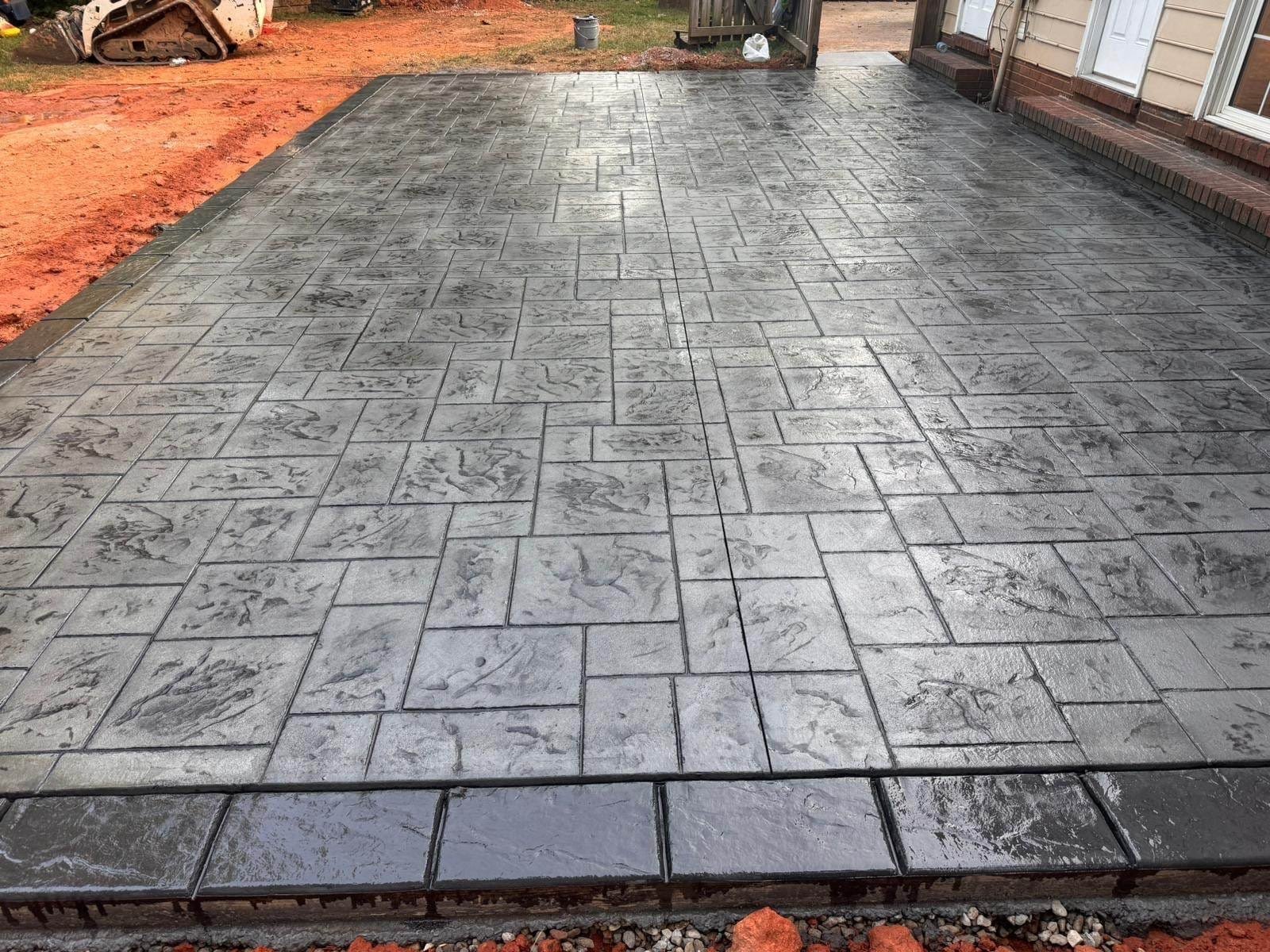
Our stamped concrete service includes discussing the finish and layout together. The example below shows a stone-style imprint and contrasting border from ARG's own work.
Water, traction and vehicle use change the decision
For an outdoor seating area, start with where water goes and how people will cross the surface when it is wet. Around a pool, discuss the texture and protective treatment together. Gloss alone is not a reliable indication of traction.
Wet areas
A slip-resistant treatment may be appropriate for pool surrounds, but no finish should be described as slip-proof. Brickform lists products intended to improve wet-area traction. The product, application and ongoing cleaning all matter.
Runoff
Ordinary pavers are not automatically a permeable drainage system. A purpose-designed permeable installation uses suitable openings, bedding and drainage layers, with cleaning to maintain flow. The CMHA permeable-pavement guide explains those maintenance needs. A different surface alone does not resolve water draining toward the house.
Vehicles
For driveways, thickness, support and expected loading must suit vehicle traffic. Do not carry a pedestrian-patio specification into a vehicle area. Turning, braking and the connection to the road need to be included in the design for either option.
Where clay, previous fill or a slope affects the yard, ask how the supporting base and drainage will be handled. The location of the job is more useful than assuming every property in the same neighborhood behaves alike.
Installation and future access
A fresh concrete finish has a curing and protection period before regular use. The time to reopen depends on the concrete mix, weather and expected load. Unit systems do not need the same slab-curing period, but bedding, compaction and any treatment must still be complete before use.
Plan an alternate route if the work blocks your normal entrance. Our pouring-weather guide covers scheduling considerations for poured work.
Planning another project later?
If a utility route may need to cross the area, pavers can be lifted and reinstated. That still involves labor, excavation and proper reinstatement; it is not a free repair. Planning sleeves and routes before concrete placement can avoid later demolition. Include future landscape changes, a kitchen or lighting in that discussion.
Which option fits your priorities?
Your initial budget is tight
Compare a straightforward stamped concrete finish against standard pavers using the same scope. If the saving is meaningful and you accept the care requirements, the concrete option may fit well. Do not compare a basic finish with a premium stone product and call the result universal.
You expect future alterations
A paver patio may be the better fit when access underneath or later reconfiguration is important. Check product availability and how the edge will be finished if you expand. Stamped concrete can also be extended, but matching an older finish should not be assumed.
You want the least upkeep
Choose the routine you will actually follow. With concrete patios, budget for protecting the finish; with paver patios, include attention to the spaces and any uneven areas. Neither option eliminates cleaning or inspection.
When weighing pavers vs stamped concrete, compare durability as a complete installation rather than a property of the surface alone. A well-planned system suited to its use matters more than a blanket promise of a fixed lifespan.
Ask these questions before accepting a quote
- Are both bids for the same measured area and intended use?
- What excavation, removal, drainage work and disposal are included?
- What is the exact product or finish, and which details could change the price?
- How will edges, transitions and movement-control details be handled?
- When can the area be used, and what care will the installer recommend?
- What does the workmanship warranty cover, separately from any product warranty?
For stamped concrete, ask to see completed work and discuss the visible cuts before choosing a pattern. For pavers, confirm the unit specification and edge-restraint details. Keep the agreed scope in writing so later comparisons are based on the same work.
A few final questions
Is one always cheaper?
No. Simple stamped concrete often costs less initially, but detailed concrete finishes, access and preparation can change the comparison. Compare equivalent scope and product quality. The cost of the material alone is not the complete project price.
Which option adds more resale value?
There is no reliable universal resale premium for choosing one over the other. Condition, design, usable space and the preferences of future buyers all affect value. Choose a surface that suits the house and your expected use rather than assuming it will return a fixed percentage.
Can I change an existing patio without removing it?
Sometimes, but it depends on condition, height and drainage. An overlay is a different system from stamping a fresh pour, and laying units over an existing surface requires a suitable design. Neither approach should be used to hide ongoing movement or water problems.
Do stamped surfaces need a glossy finish?
No. The look depends on the coloring and protective system selected. Ask about sheen, traction and compatibility before choosing a sealer. A sample helps compare the appearance with the rest of the yard and adjoining concrete.